The Case Against Humanoids
Part of the AI Economics topic guide.
Why the economics of commercial robotics favor purpose-built machines over bipedal generalists.
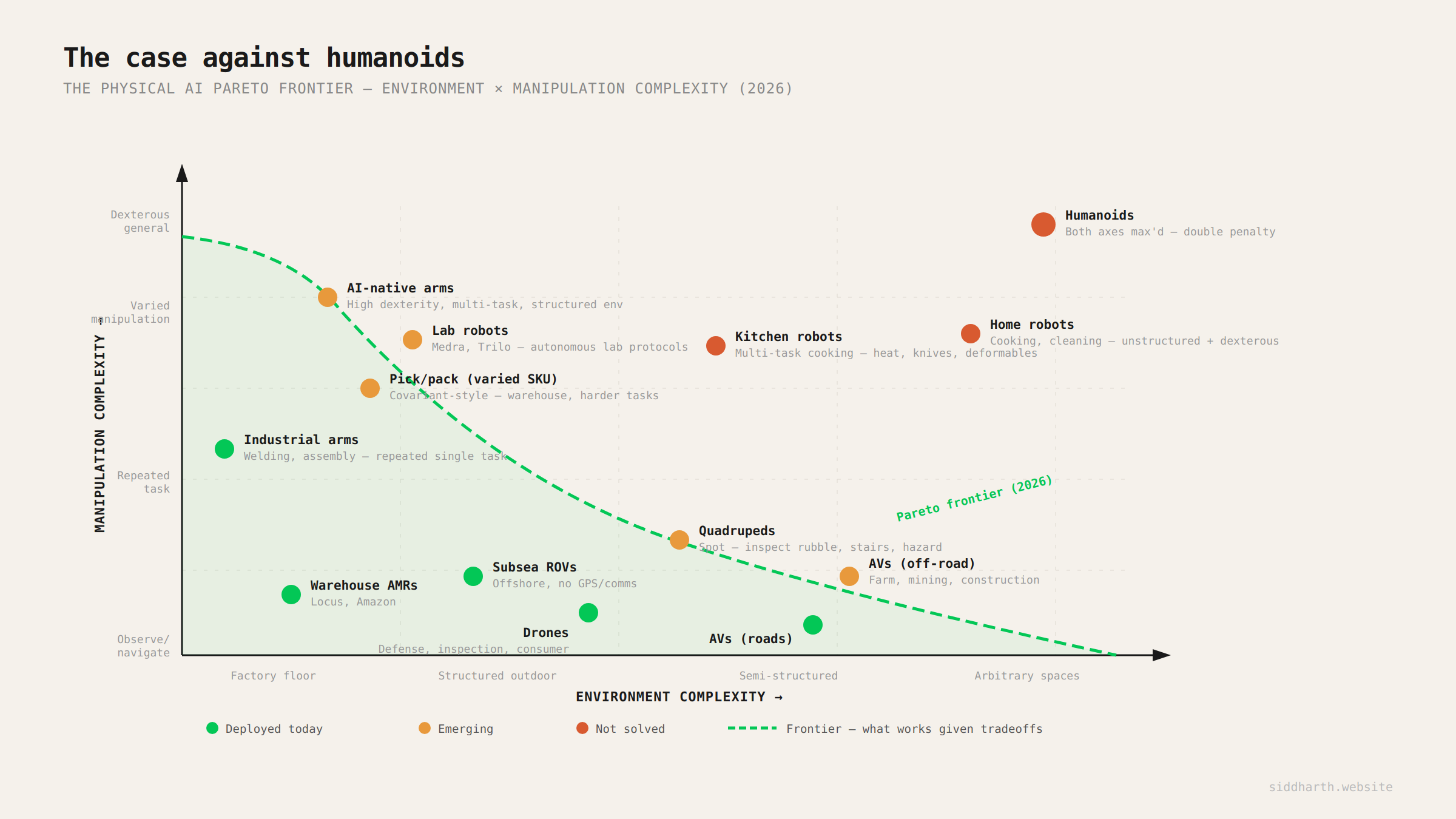
The Humanoid Hype Machine
Figure AI just raised ~$1.5B at a ~$40B valuation. Tesla's betting the company on Optimus. 1X raised $100M from OpenAI. Apptronik is building humanoids for NASA and Mercedes.
Walk down Sand Hill Road and every robotics pitch deck has the same slide 3: a bipedal robot stacking boxes or folding laundry. The investment thesis is seductive in its simplicity:
"The world is built for humans. We have $50 trillion of infrastructure designed around human bodies - stairs, doorways, countertops, tool handles. So obviously, robots should be shaped like humans."
It makes intuitive sense, but it's also mostly wrong.
Built to Win
There's no environment more "built for humans" than sports. We invented every part of it - the rules, the dimensions, the equipment. It exists purely for human competition. For thousands of years, only humans have played.
Sports is the strongest possible case for the humanoid thesis. If "the world is built for humans, so robots should look like humans" logic works anywhere, it should work here.
So, if you were building a robot team to win a championship - no constraints, just optimize for winning - would you build something that looks like a human?
Optimization Beats Imitation
January 10, 1982. The Catch. An iconic play not just for the 49ers but for all NFL fans (read as: Cowboys haters).
Montana immediately rolls right after the snap, goes through all his reads, and then just as he is about to be swarmed by 3 defenders and sacked he throws the ball up high to the back of the end zone. Dwight Clark leaps multiple feet into the air, extends his arms as high as they can possibly go, and somehow pulls the ball down with both feet inbounds.
Perfect execution under impossible pressure. This is what makes sports beautiful.
In a robo-NFL league what would a QB-bot actually look like? Not Joe Montana. You'd just build a ball cannon with cameras and lidar. Perfect velocity calculations. Perfect arc every time.
And Dwight Clark-bot? Likely not a 6'4" humanoid leaping into the air. You'd build a large net on wheels. Or maybe a sophisticated gripper array on an extending arm. Something that doesn't need to jump, doesn't need to worry about balance, doesn't need to time its leap perfectly.
When you're optimizing for winning, you don't constrain yourself to human limitations. You optimize for the task.
February 27, 2016. GSW vs. OKC. Steph Curry, the greatest shooter of all time, pulls up 38 feet from the basket. He releases the ball up and over the taller Roberson to sink the three-pointer and win the game. "BANG! BANG! OH WHAT A SHOT FROM CURRY!"
One of the most iconic calls in sports history.
But even Steph Curry wouldn't get drafted in a robo-NBA league. Purdue students built a basketball robot over 6 years ago that could drain a shot from anywhere on the court without missing.
The Purdue basketball robot. It's not a humanoid. It's just a set of gears and springs on wheels with sensors to calculate the arc. No arms, no jumping motion, no follow-through. It doesn't need to practice its shooting form for thousands of hours like Steph did.
It just shoots, and it doesn't miss.
Why build a humanoid that needs to learn and practice when you can build a machine that physically cannot miss?
May 28, 1998. Arizona vs. San Francisco. Okay yeah, not sure we can build a robot to beat Barry Bonds.
When the goal is pure performance, when winning is all that matters, you don't build robots that look like humans.
You build robots optimized for the specific task. Ball cannons. Gripper arrays. Shooting machines.
The human form isn't the optimal solution. It's just the constraint we are stuck with as humans.
We Already Know This
This isn't just a thought experiment. We already ran this experiment in the real world. And the stakes were way higher than just the 2026 Finals.
When factories started deploying robots in the 1960s, they didn't build humanoid robots and slot them into existing assembly lines. They built factories AROUND the robots. When you have a mechanical task that gets performed thousands of times per day, you build something that works optimally for that specific task.
We already know task-specific beats general-purpose for repeated work.
Look at agriculture. We don't have humanoid robots in fields picking fruit by hand. We built tree shakers that can harvest an entire tree in seconds - something no human or humanoid robot could ever do. We built autonomous tractors that can work 24/7 with centimeter-level precision.
We didn't build mechanical horses for transportation. We built cars with wheels.
We didn't build Rosey the Robot to wash dishes by hand. We built dishwashers that use less water and clean faster than any human could.
Every single time we've had to automate a physical task at scale, we've chosen task-specific optimization over human-like form. And it's worked spectacularly well.
So if we already learned this lesson 60 years ago, why are people suddenly betting billions on humanoid robots?
So Why the Humanoid Hype Now?
Foundation Models - You can't collect task-specific training data for every possible robot configuration. But you CAN collect massive amounts of human demonstration data - YouTube videos, teleoperation sessions, motion capture. Build a humanoid, train it on how humans perform tasks, and maybe it can transfer that learning to anything.
The Long Tail of Tasks - A warehouse might have 10 common tasks you can automate with specialized robots. But it also has 1,000 rare tasks - reorganizing after a flood, handling damaged packages, helping with inventory audits. You can't build a custom robot for each of those. You need a generalist.
Hardware Costs are Plummeting - Tesla claims Optimus will eventually cost $20K-30K to manufacture. At that price point, the economics completely flip. Even if it's less efficient than a specialized robot, if it's cheap enough and versatile enough, who cares?
These are legitimate arguments from smart people deploying serious capital.
They're also wrong for most applications. And understanding why requires looking at the actual economics of robot deployment.
The 6 Million Dollar Question
Most robotics applications are high-volume, repetitive tasks in controlled environments.
Think about what actually drives robotics deployment today:
Warehouses: Pick item, scan item, place item, move to next location. Repeat 200 times per hour, 10 hours per day, 250 days per year. That's 500,000 repetitions annually of essentially the same motions.
Manufacturing: Weld joint, move 6 inches, weld joint, move 6 inches. Same part, same motion, every 30 seconds, for years.
Agriculture: Drive down row, identify crop, harvest, move forward 3 feet. Repeat for 40 acres. Then do the same 40 acres next week. And the week after.
Inspection: Walk the same pipeline route. Check the same bridge supports. Scan the same warehouse racks. Same environment, same pattern, daily.
For these applications (which represent the vast majority of the robotics market) specialized robots will ALWAYS beat humanoids on economics.
Let's actually do the math on a warehouse, since that's where a lot of the humanoids are focused:
Locus Robotics (specialized warehouse AMR):
- Unit cost: <$13,000 / year (RaaS)
- Picks per hour: 100-150
- Power consumption: 50W
- Failure mode: Stops moving, easy to retrieve
- Lifespan: 7-10 years
- Maintenance: Minimal, mostly battery replacement
Figure 01 (humanoid warehouse robot):
- Unit cost: $150,000+ (estimated, being generous)
- Picks per hour: 30-50 (current demos)
- Power consumption: 500W+ (bipedal locomotion is expensive)
- Failure mode: Falls over, potentially damages inventory and itself
- Lifespan: Unknown, but more failure points
- Maintenance: Complex - joints, actuators, balance systems
A warehouse doing 2 million picks per year would need:
- Locus: ~10 robots = $130K / year + minimal upfront and operating costs
- Humanoid: ~45 robots = $6.75M capital + 10x the power + much higher maintenance
You'd need to believe the humanoid can do something the Locus can't to justify spending $6M+ more.
"But humanoids can handle the long tail of tasks!"
The rare tasks in a warehouse are things like: cleaning up a spill, reorganizing after a water leak, handling a damaged package that won't scan, retrieving an item from an odd location, helping during peak season surges.
Most of these tasks happen maybe once per week or less. You're not deploying a $150K robot to handle weekly edge cases, and you can often solve these with cheaper solutions. A $20K robotic arm on a mobile base can handle many "unusual" picks without needing the full humanoid form.
Humanoids only makes economic sense when:
- Task variety is extreme - Not 10 tasks or 50 tasks, but truly hundreds of different manipulation tasks
- Volume per task is low - Each task happens rarely enough that you can't amortize custom tooling
- Environment is genuinely unstructured - Not "has stairs," but "changes in unpredictable ways"
- You cannot modify the environment - For some reason, you absolutely cannot add a ramp, change a doorway, or adjust tooling
That intersection (high variety, low volume, unstructured / unchangeable environment) is a much, much smaller market than the humanoid hype suggests.
Where Specialization Wins
So if humanoids aren't the answer for most applications, what is? Here's what I think actually wins over the next 5 years:
Prediction 1: Wheels beat legs for 90%+ of commercial applications
Bipedal locomotion uses 10-20x more energy than wheels for the same distance traveled. It's mechanically complex, requires constant active balancing, and has a catastrophic failure mode: falling over.
"But what about stairs?"
Stairs are a solved problem. For industrial applications, you add a ramp or use a freight elevator. The cost of modifying a facility is almost always cheaper than buying bipedal robots. And for the rare cases where you truly can't modify the environment, there are other solutions.
Companies doing this right:
Locus Robotics - Over 15,000+ warehouse robots deployed. Wheels. They're not sexy, but they work, they're profitable, and they're scaling.
Built Robotics - Autonomous construction equipment. Excavators, dozers, compactors. They didn't try to build a humanoid construction worker - they automated the actual equipment that does the work.
Gecko Robotics - Wall-climbing inspection robots. Need to inspect the inside of a boiler or the underside of a bridge? Don't send a humanoid with a ladder. Send a magnetic crawler that can't fall off.
Prediction 2: Modular platforms beat monolithic humanoids
Here's a better approach to "general purpose" robots: Build one really good base, then swap tools for different jobs.
The expensive parts are locomotion, compute, power, and sensors. That's 80% of the cost. The gripper or cutting tool? That's maybe 10-20% of the cost.
So instead of building a $150K humanoid that does everything mediocrely, build a $50K mobile platform that can swap between a dozen different specialized tools in 30 seconds.
Companies doing this:
Farm-ng - Modular agricultural platform. Same robot base, different attachments for mowing, spraying, tilling, hauling.
Clearpath Robotics - Mobile bases that researchers and companies customize with different payloads. One platform, hundreds of applications.
Outrider - Autonomous yard truck platform for distribution centers. The base handles the driving, you can swap what it's pulling or carrying.
Boston Dynamics (Spot) - Say what you will about the robot dog, but the platform approach works. Same quadruped base, customers mount different sensors, arms, and tools for their specific use case.
The economics are straightforward: amortize the expensive platform, keep the task-specific tools cheap and swappable.
Prediction 3: Vertical-specific solutions dominate
The winners will be building the perfect robot for a specific job.
Agriculture: Carbon Robotics built an autonomous laser weeding robot that kills 100,000 weeds per hour with precision lasers. Not a humanoid bending over with a hoe - a specialized machine that can work 24/7 with millimeter accuracy, eliminating the need for herbicides entirely.
Construction: Hadrian X is a bricklaying robot that can lay 500 bricks per hour compared to a human's 300. It's not a humanoid holding a trowel - it's a robotic arm on a truck that never gets tired, never makes alignment errors, and can work through the night.
Inspection: Gecko Robotics builds wall-climbing robots that inspect the inside of boilers, tanks, and ship hulls. Try sending a humanoid up a 50-foot vertical boiler wall. Or just send a magnetic crawler that can't fall off and captures ultrasonic thickness data as it goes.
Warehouse & Logistics: Locus Robotics has deployed over 15,000 picking assistance robots in warehouses globally. Wheels, not legs. Simple gripper systems, not general-purpose hands. They do one thing exceptionally well: help human workers pick and move items faster.
Manufacturing: Universal Robots has deployed over 50,000 collaborative robot arms worldwide. Not full humanoid bodies - just arms that can work safely next to humans on assembly lines, doing repetitive tasks with perfect consistency.
Each picked ONE problem, understood it deeply, and built a robot that's 10x better than a human at that specific task. That's how you build a robotics business.
Where Humanoids Might Make Sense
I'm not saying humanoids will never work. There are real applications where the form factor makes sense.
True generalist environments with unchangeable infrastructure
If you genuinely need ONE robot to perform 100+ different manipulation tasks in an environment you absolutely cannot modify, humanoid might be your only option. Historic buildings where you can't add ramps. Luxury hotels where industrial equipment would ruin the aesthetics. Homes where the environment is fundamentally designed for human bodies and changes constantly.
The home robot market deserves special attention because it's genuinely massive - 140 million US households. If you could sell a useful home robot to even 10% of them, that's 14 million units, a scale that could actually justify humanoid valuations. This is the one application where the economics might eventually make sense.
But we're not ready. Current humanoids can barely fold laundry in lab conditions. A real home needs a robot that can load a dishwasher, pick up scattered toys, make beds, put away groceries, and clean around delicate objects - all while adapting to how different people organize their homes. We're years away from this working reliably.
Then there's social acceptance. Most people aren't comfortable with a camera-equipped humanoid roaming their house unsupervised, especially around children and pets. Even if the technology worked tomorrow, adoption would take years. Smart speakers and home cameras took time, and those don't move around or manipulate objects.
And the economics: The PC revolution took off when computers dropped below $2,000. Home humanoids probably need to cost under $5,000-10,000 for mass adoption. Current prototypes cost $100,000+. Even Tesla's optimistic $20,000-30,000 projection is still 3-6x too expensive for most families.
Home robots could eventually be huge. But solving these technical, social, and economic challenges will take 10-15 years.
For everything else - historic buildings, luxury hotels, museums - these are low-volume markets. You're not deploying tens of thousands of humanoids into historic buildings every year.
Human interaction and trust
When a robot needs to regularly interact with people - especially vulnerable populations like children, elderly, or patients - the humanoid form factor can build trust and reduce anxiety.
A humanoid receptionist in a hotel feels more approachable than a kiosk. A humanoid assistant in elder care might be less intimidating than an industrial-looking machine. The form factor itself provides value.
Companies working on this:
- Embodied (Moxie) - Social robot for children
- Diligent Robotics (Moxi) - Hospital delivery robot with friendly humanoid design
- SoftBank Robotics (Pepper) - Customer service robot for retail
Research and experimentation platforms
If you're a researcher studying human-robot interaction, learning algorithms, or general manipulation, you need a humanoid platform to run experiments on.
Fauna Robotics is taking a different approach - building Sprout, a humanoid specifically designed from the ground up to operate safely around people. It's lightweight (50 lbs), has a soft exterior, compliant controls, and is small enough (3.5 feet) to feel less intimidating in shared spaces. They're targeting retail, hospitality, education, and home environments where the form factor matters for human interaction and trust.
Pure aesthetics
Sometimes people just want their robot to look human, even if it's not optimal. Museums, showrooms, entertainment venues. The form is a feature, not a bug.
These are all niche, low-volume, or experimental applications.
None of them are "deploy 50,000 units into warehouses and factories that work 24/7." Humanoids can win in specific contexts. They're just not going to be the dominant robotics form factor of the next decade.
The Real Opportunity
The robotics opportunity is massive and real. We're absolutely going to automate millions of physical tasks over the next decade. Labor costs are rising, technology is improving, and the economics increasingly favor automation.
But the winning strategy isn't "build a general-purpose humanoid and hope foundation models figure out the rest."
It's the same playbook that's worked for 60 years: Deeply understand a high-value task, build the optimal form factor for that specific task, and scale the hell out of it.
Foundation models are genuinely exciting. They'll make robots smarter, more adaptive, and easier to deploy. But they don't change the fundamental physics of bipedal locomotion using 10x more energy than wheels. They don't change the economics of a $150,000 robot competing against a <$10,000 specialized alternative. They don't eliminate the fact that when you optimize for a specific task, you get better performance at lower cost.
We didn't build mechanical horses and then teach them to navigate roads with AI. We built cars because wheels are better for transportation. We didn't build humanoid dish-washers and train them on YouTube videos of people washing dishes. We built dishwashers because they're better at washing dishes.
The same logic applies today. If you're automating warehouse picking, build the best picking robot. If you're automating fruit harvesting, build the best harvesting robot. If you're automating construction, automate the actual construction equipment.
Foundation models will make robots smarter and more adaptive. But they don't change the fundamental physics - bipedal locomotion still uses 10x more energy than wheels. They don't change the economics - specialized robots will always be cheaper for high-volume tasks. And they don't change the logic we've known for decades: when you optimize for performance, you optimize for the task, not the form.
You wouldn't build Tom Brady to win a Super Bowl, and you shouldn't build a humanoid to automate a warehouse.